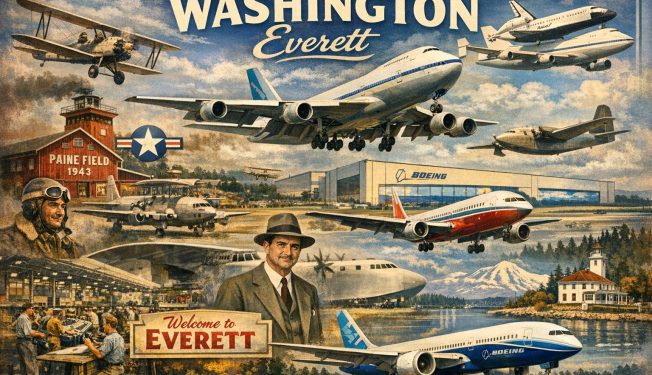
The Emergence of Everett in Aviation
Everett, Washington, occupies a central place in the development of modern aviation in the United States. Positioned along the Puget Sound with access to deep-water ports, rail infrastructure, and expanding urban centers, the city evolved into a strategic site for aircraft manufacturing and aerospace research. Its trajectory was influenced by geographic advantages, industrial policy, and the presence of major aerospace firms, particularly Boeing. Over time, Everett became associated with large-scale aircraft production, workforce specialization, and technological innovation in aviation.
The Beginnings of Aviation in Everett
Aviation activity in Everett can be traced to the early 20th century, when aviation itself was transitioning from experimental flight to structured industrial practice. During the 1920s and 1930s, regional interest in aviation grew alongside national developments in air transport and military preparedness. Everett’s proximity to Seattle, where Boeing was founded in 1916, made it a natural extension for aviation-related expansion.
By the late 1930s, the United States government had begun investing heavily in airfields and aviation infrastructure as part of broader defense readiness efforts. Everett benefited from these initiatives due to its available land and coastal location. The establishment of Paine Field in 1943 marked a defining moment in the city’s aviation history. Initially constructed as a military airfield during World War II, it functioned as a training and logistics base for the U.S. Army Air Forces.
The presence of Paine Field brought an influx of personnel, technical expertise, and federal investment into the region. It also created a foundational infrastructure that could later be adapted for civilian and industrial aerospace use. After the war, like many military installations, Paine Field underwent a transition period, eventually becoming a civilian airport while retaining its importance in national defense frameworks.
The Boeing Influence
Boeing’s decision in 1966 to build its new wide-body aircraft, the 747, in Everett marked a transformative phase for the city. The scale of the project required an entirely new facility capable of assembling aircraft far larger than anything previously produced. Construction of the Everett assembly plant began shortly after the site was selected, and the resulting building became the largest in the world by volume.
The significance of Boeing’s move extended beyond physical infrastructure. It established Everett as a focal point for wide-body aircraft production and elevated the city’s status within the global aerospace industry. The 747 program itself represented a shift in commercial aviation, enabling long-haul, high-capacity air travel at a scale previously unattainable. Everett became synonymous with this shift, as the aircraft was assembled, tested, and delivered from the site.
Over the following decades, Boeing expanded operations in Everett to include additional aircraft programs. The facility has housed production lines for models such as the 767, 777, and 787 Dreamliner. Each program introduced new manufacturing techniques, materials, and design processes. For example, the 787 program incorporated composite materials and advanced aerodynamics, requiring updated assembly methods and a global supply chain integration system.
The Everett plant has also played a role in workforce development. Thousands of engineers, machinists, technicians, and support staff have been employed at the facility, contributing to the growth of a highly specialized labor market in the region. Training programs and partnerships with local educational institutions have supported this workforce, further embedding aerospace expertise into the local economy.
Paine Field’s Role
Paine Field remains a key component of Everett’s aviation ecosystem. While it originated as a military installation, it now functions as a mixed-use airport supporting commercial, general aviation, and industrial operations. Its long runways and proximity to Boeing’s facilities make it particularly well-suited for aircraft testing, delivery, and maintenance activities.
The airport also serves as a public-facing gateway to aviation through the Future of Flight Aviation Center & Boeing Tour. This facility provides educational exhibits and guided tours, offering insights into aircraft design, assembly processes, and the broader aerospace industry. It has become a significant site for tourism, connecting the public with the technical and industrial aspects of aviation.
In recent years, Paine Field has expanded its commercial passenger services through a dedicated terminal. This development introduced regional air travel options for residents of Snohomish County and surrounding areas, reducing reliance on larger airports such as Seattle-Tacoma International Airport. The addition of commercial services reflects the airport’s evolving role in regional transportation infrastructure.
Beyond passenger service, Paine Field supports a range of aviation-related businesses, including maintenance, repair, and overhaul (MRO) providers, charter services, and flight training organizations. This diversity contributes to a stable and adaptable aviation economy within Everett.
Modern Developments and Beyond
Today, Everett continues to function as a central hub for aerospace activity, supported by both legacy infrastructure and ongoing innovation. Advances in aircraft design, including improvements in fuel efficiency, materials science, and avionics, are reflected in the work conducted at Everett’s facilities. Boeing remains the dominant presence, but the surrounding ecosystem includes suppliers, research institutions, and service companies that collectively shape the city’s aviation profile.
Sustainability has become an increasing focus within the aerospace sector, and Everett is part of this shift. Efforts to reduce emissions, develop sustainable aviation fuels, and improve manufacturing efficiency are being integrated into current and future projects. These initiatives align with broader industry trends aimed at addressing environmental and regulatory challenges.
Economic fluctuations and shifts in global demand have periodically affected the scale and pace of operations in Everett. Changes in aircraft programs, production rates, and market conditions have influenced employment levels and investment patterns. Despite these variations, the city has maintained its relevance by adapting to industry needs and maintaining a skilled workforce.
Infrastructure development continues to support Everett’s aviation activities. Upgrades to transportation networks, port facilities, and industrial zones enhance the movement of materials and finished aircraft. Digital technologies, including automation and data analytics, are increasingly integrated into manufacturing and logistics processes, improving efficiency and traceability.
Looking ahead, Everett is positioned to remain a significant contributor to the aerospace industry. Its combination of established manufacturing capacity, technical expertise, and strategic location provides a strong foundation for future developments. Whether through the evolution of existing aircraft programs or the introduction of new technologies, the city is likely to continue playing a role in shaping the direction of aviation.
Everett’s aviation history reflects a broader narrative of industrial growth, technological progress, and regional development. From its early days as a military airfield to its status as a global center for aircraft production, the city demonstrates how infrastructure, industry, and innovation can converge to create lasting economic and technological impact.