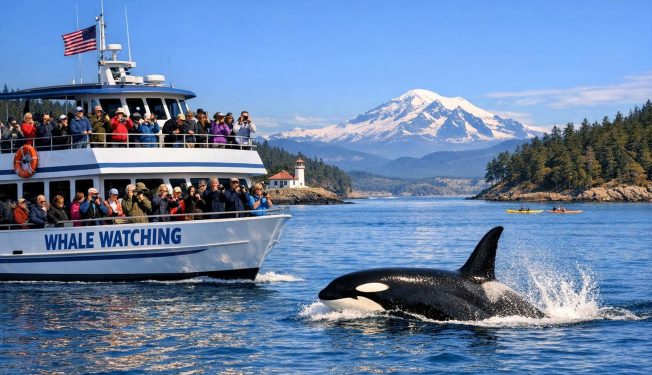
Introduction to Whale Watching in the San Juan Islands
Whale watching in the San Juan Islands provides a sustained and close perspective on marine ecosystems shaped by ocean currents, seasonal migrations, and long-established ecological relationships. Situated in the Salish Sea, between mainland Washington and Vancouver Island, this island archipelago combines protected waterways with nutrient-rich habitats that support a wide range of species. These conditions make the region particularly well-suited for observing whales in a relatively accessible yet ecologically complex setting.
The islands themselves form a network of channels, passages, and open waters that act as travel corridors for marine mammals. Whale presence in this area is not random; it is closely tied to prey availability, water temperature, and broader ocean conditions. As a result, sightings often reflect larger environmental patterns. This allows visitors not only to observe whales but also to gain insight into the functioning of marine ecosystems.
Unlike some forms of wildlife tourism that rely on artificial attractants or predictable feeding sites, whale watching in the San Juan Islands generally involves locating animals that are actively traveling, foraging, or socializing. This creates a dynamic viewing experience influenced by tides, weather conditions, and daily shifts in whale movement. As a consequence, no two outings are identical, and the experience often emphasizes observation rather than guaranteed encounters.
Geographic and Ecological Context
The San Juan Islands lie within a transitional marine zone where freshwater from rivers mixes with saltwater from the Pacific Ocean. This mix contributes to high biological productivity, supporting plankton populations that form the base of the marine food web. Small fish, including herring and salmon, are abundant in these waters, which in turn attract larger predators such as seals, seabirds, and whales.
The underwater topography of the region further enhances its suitability for marine life. Deep channels allow whales to travel efficiently, while shallower banks create feeding grounds where prey becomes concentrated. Seasonal upwellings bring nutrients to the surface, reinforcing the productivity of the ecosystem. These features contribute to consistent, though not guaranteed, whale activity throughout much of the year.
Human activity is also part of this landscape. Ferry routes, recreational boating, and commercial traffic all intersect with whale habitat. Regulations and management strategies aim to balance these uses with conservation goals, reflecting the recognition that the health of the ecosystem depends on careful stewardship.
Best Time for Whale Watching
Whale watching occurs year-round in the San Juan Islands, but the period between May and September is generally considered the most active. During these months, weather conditions tend to be more stable, with calmer seas and improved visibility. These factors increase both the likelihood of sightings and the overall comfort of being on the water.
Summer also coincides with the peak presence of certain whale populations, particularly orcas that follow salmon runs through the region. The availability of prey directly influences whale movement, so years with strong salmon returns often correlate with increased whale activity. However, environmental variability means that each season can differ, and long-term trends are influenced by factors such as ocean temperature and fish population health.
Spring and early autumn can also offer productive viewing opportunities, especially for migratory species such as gray whales and humpbacks. Winter whale watching is less common but still possible, primarily focused on transient orcas and occasional resident groups. These off-peak periods often involve fewer boats on the water, which can result in quieter observation conditions.
Whale Species Commonly Seen
Several whale species are regularly observed in the San Juan Islands, each with distinct behaviors and ecological roles. Among the most recognized are the Southern Resident orcas, a population that has been the subject of extensive research due to its cultural complexity and conservation status. These whales are fish-eating specialists, relying heavily on Chinook salmon. Their movements are therefore closely aligned with salmon distribution, making them a seasonal presence in the region.
In contrast, transient orcas, also known as Bigg’s killer whales, are mammal hunters. They feed on seals, porpoises, and other marine mammals, and their behavior differs significantly from that of resident populations. Transient orcas tend to travel in smaller groups and exhibit quieter, more stealth-oriented movement patterns. Their increasing presence in the Salish Sea reflects broader changes in marine ecosystems.
Humpback whales have become more common in recent years, following a period of decline due to historical whaling. Their recovery is often cited as an example of successful international conservation efforts. These whales are known for their feeding techniques, such as bubble net feeding, and their occasional breaching behavior. While not always predictable, humpback sightings have become a regular feature of whale watching tours.
Gray whales are typically observed during migration periods, particularly in the spring. Some individuals, referred to as “sounders,” remain in the region to feed on ghost shrimp and other benthic organisms. Minke whales, the smallest baleen whales commonly seen in the area, are more elusive and often identified by subtle surface movements rather than dramatic displays.
Local Tours and Guidelines
Whale watching tours in the San Juan Islands are conducted by a range of operators, many of whom follow established guidelines designed to minimize disturbance to marine life. These tours vary in format, including large vessels, rigid inflatable boats, and occasionally kayak-based excursions. Each approach offers a different perspective, with trade-offs in terms of stability, speed, and proximity.
Licensed operators are typically required to adhere to regional regulations, including minimum approach distances and speed restrictions near whales. These rules are informed by scientific research on whale behavior and stress responses. Maintaining appropriate distances helps reduce the risk of disrupting feeding, communication, and social interaction among whales.
In addition to regulatory compliance, many operators incorporate educational components into their tours. Naturalists or guides often provide context about whale biology, migration patterns, and conservation challenges. This information contributes to a broader understanding of the marine environment and encourages responsible behavior among visitors.
Choosing a tour operator that emphasizes sustainability can influence the overall impact of whale watching activities. Organizations that participate in research initiatives or contribute to conservation programs may offer added value beyond the immediate viewing experience. This reflects a growing trend in wildlife tourism toward integrating observation with stewardship.
Land-Based Whale Watching
While boat tours provide mobility and access to a wider area, land-based whale watching is an alternative that requires no direct interaction with marine vessels. Several locations in the San Juan Islands offer elevated viewpoints overlooking key channels where whales are known to travel. Lime Kiln Point State Park on San Juan Island is one of the most well-known sites, often referred to as one of the best land-based whale watching locations in the world.
From shore, observers rely on visual cues such as dorsal fins, blows, and surface disturbances. This approach requires patience and attention but eliminates the potential for vessel-related disturbance. In some cases, whales pass close enough to shore to provide clear views, especially in narrow channels where travel routes are constrained by geography.
Interpretive signage and visitor centers at these locations often provide background information on whale identification and behavior. Hydrophones installed at certain sites allow visitors to listen to underwater sounds, offering an additional dimension to the experience.
Conservation Efforts and Responsible Watching
Conservation in the San Juan Islands focuses on multiple aspects of ecosystem health, including water quality, prey availability, and noise pollution. Whale populations, particularly the Southern Resident orcas, face ongoing challenges related to declining salmon stocks, vessel disturbance, and environmental contaminants. Addressing these issues requires coordinated efforts across local, national, and international levels.
Regulations governing vessel distance and speed near whales are one component of conservation strategy. Enforcement is supported by monitoring programs and public reporting systems. In addition to formal regulations, voluntary guidelines encourage boaters to reduce engine noise and avoid positioning vessels directly in the path of whale travel.
Public education plays a central role in these efforts. Visitors are encouraged to familiarize themselves with responsible viewing practices, such as those outlined by the San Juan Islands Whale Watching Guidelines. These guidelines emphasize maintaining distance, limiting viewing time, and avoiding sudden movements that could startle animals.
Research initiatives contribute to a deeper understanding of whale behavior and population trends. Photo identification, acoustic monitoring, and satellite tracking are among the methods used to study whale movement and health. Data gathered through these efforts informs management decisions and helps assess the effectiveness of conservation measures.
Sustainable tourism is increasingly viewed as part of the conservation framework. By supporting operators and organizations that prioritize ecological responsibility, visitors can contribute indirectly to preservation efforts. This approach aligns economic activity with environmental protection, though it requires ongoing oversight to ensure that tourism levels remain within sustainable limits.
In the long term, the future of whale watching in the San Juan Islands depends on maintaining the conditions that support marine life. This includes not only protecting whales themselves but also addressing broader environmental factors such as climate change, ocean acidification, and habitat degradation. Observing whales in this region provides a direct connection to these larger issues, linking individual experiences with global environmental processes.