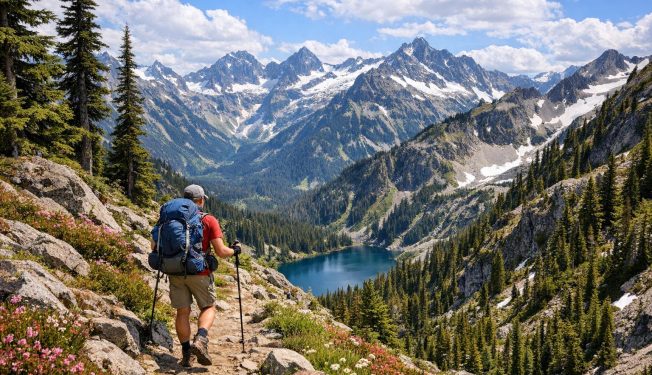
Overview of the North Cascades
The North Cascades form one of the most complex and visually striking mountain systems in North America. Located in northern Washington State and extending into British Columbia, this region combines sharp, jagged peaks with deep glacial valleys and densely forested lowlands. The terrain reflects a long geological history shaped by tectonic activity, uplift, and extensive glaciation. Often described as remote compared to other U.S. national parks, the area remains less developed, which contributes to its enduring ecological integrity and sense of isolation.
At the center of this region lies the North Cascades National Park, which, together with Ross Lake and Lake Chelan National Recreation Areas, preserves a wide range of landscapes. The park is not dominated by roads and infrastructure. Instead, it offers a largely uninterrupted wilderness, where access often requires hiking or boating. This contributes to lower visitor numbers compared to more accessible parks, but it also means that those who travel here encounter environments that are comparatively undisturbed.
Geography and Ecology
The geography of the North Cascades is characterized by steep elevation gradients that create a patchwork of ecosystems across relatively short distances. Moisture carried by Pacific weather systems rises over the mountains and deposits significant precipitation on the western slopes. This leads to dense temperate rainforests populated by species such as western red cedar, Douglas-fir, and hemlock. Mosses, ferns, and understory plants thrive in this environment, forming layered vegetation structures.
As elevation increases, forests thin and transition into subalpine zones, where shorter growing seasons and harsher conditions limit plant height and diversity. Alpine meadows appear in these areas, often filled with seasonal wildflowers that bloom briefly during summer. Higher still, vegetation becomes sparse, and exposed rock and ice dominate the landscape.
The eastern slopes present a contrast. Due to the rain shadow effect, this side of the range receives significantly less precipitation. Forests here are more open, featuring drought-tolerant species such as ponderosa pine. Shrub-steppe environments appear at lower elevations, supporting different ecological communities.
One of the defining features of the North Cascades is its concentration of glaciers. With over 300 glaciers, the region contains the largest collection of active glaciers in the contiguous United States. These glaciers play a critical role in shaping the terrain and influencing hydrology. Meltwater feeds rivers and lakes, contributing to downstream ecosystems and water systems used for agriculture and urban supply.
Wildlife in the North Cascades reflects the diversity of habitats. Large mammals such as black bears and mountain goats are commonly associated with the region. Smaller mammals, including pikas and marmots, inhabit alpine areas, while dense forests support species like deer and elk. Bird diversity is also notable, with migratory and resident species occupying different ecological niches throughout the year. Predator species such as gray wolves have been documented returning to parts of the greater ecosystem, indicating ongoing ecological shifts.
Popular Hiking Trails
Hiking provides one of the most direct ways to experience the North Cascades. The region offers a wide range of trails that vary in length, elevation gain, and accessibility. Some routes require technical skill and careful preparation, while others are suitable for casual exploration.
The Sahale Arm Trail is frequently cited as one of the most visually rewarding routes in the park. Beginning near Cascade Pass, the trail ascends through alpine terrain, providing views of glaciated peaks and steep ridgelines. As hikers gain elevation, the surrounding landscape opens into expansive vistas, revealing the scale of the mountain system.
The Maple Pass Loop is another well-known route, particularly during autumn when foliage changes color. This trail offers a combination of forested sections and exposed alpine segments, creating varied scenery within a relatively moderate distance. Its loop format allows hikers to experience different perspectives without retracing their steps.
The Hidden Lake Lookout trail leads to a historic fire lookout situated above a remote alpine lake. The route includes both maintained paths and steeper, rockier segments. Upon reaching the lookout, visitors encounter panoramic views that include surrounding peaks and valleys shaped by glacial activity.
For those seeking less demanding terrain, the Thunder Creek Trail provides a more gradual route through old-growth forests. Following a river corridor, this trail allows visitors to engage with the lower-elevation ecosystems of the park. The relatively gentle elevation gain makes it accessible to a broader range of hikers, while still offering a sense of immersion in the natural environment.
In addition to these routes, numerous lesser-known trails extend into backcountry areas. These paths often require permits and careful trip planning. The limited infrastructure in many sections means that hikers must rely on navigation skills and self-sufficiency.
Climate and Seasonal Variation
The climate of the North Cascades varies significantly depending on elevation and location within the range. Western slopes are generally wetter and subject to frequent cloud cover, especially outside of the summer months. Snowfall in winter is substantial, contributing to the region’s glaciers and seasonal snowpack.
Summer represents the primary hiking season, typically extending from late June through September. During this time, snow recedes from many lower and mid-elevation trails, although higher routes may still retain snowfields. Weather conditions can appear stable during this period, but sudden changes remain possible, particularly at higher elevations.
Autumn brings cooler temperatures and clearer skies, often providing increased visibility for viewing distant peaks. However, snowfall can begin early in some years, limiting access to higher elevations. Winter conditions transform the region into an environment suitable for activities such as snowshoeing and backcountry skiing, though these activities require specialized equipment and knowledge of avalanche risks.
Spring is characterized by snowmelt and rising river levels. Trails may be muddy or partially snow-covered, and access can be limited by lingering winter conditions. Despite these challenges, spring also marks the return of plant growth and wildlife activity.
Human History and Land Use
The North Cascades have a long history of human presence, beginning with Indigenous communities who have lived in and around the region for thousands of years. These communities developed detailed knowledge of seasonal resources, migration patterns, and landscape features. Their cultural connections to the land continue today, and tribal nations remain active in conservation and land management discussions.
European American exploration began in the 19th century, driven by interests in fur trading, mining, and surveying. While the rugged terrain limited large-scale settlement, some mining operations and small communities emerged in accessible areas. Evidence of these activities remains visible in the form of abandoned structures and historic routes.
The establishment of North Cascades National Park in 1968 marked a shift toward preservation. The park was created to protect the region’s ecological and geological features from development pressures. Adjacent lands managed by the U.S. Forest Service provide additional recreational opportunities while balancing conservation with resource use.
Hydropower development has also influenced the region, particularly along the Skagit River. Dams such as Ross Dam and Diablo Dam create large reservoirs that are integrated into the broader landscape. These structures contribute to regional energy supply but also alter natural river systems.
Safety and Considerations
Travel in the North Cascades requires attention to safety due to the combination of remote terrain and variable environmental conditions. Weather can change rapidly, particularly in higher elevations where storms may develop with limited warning. Visibility can decrease quickly in fog or precipitation, making navigation more difficult.
Preparation is essential. Visitors are generally advised to carry appropriate gear, including navigation tools, sufficient food and water, and clothing suited to changing conditions. Because cell service is often unavailable, communication plans should not rely solely on mobile devices. Informing others of intended travel routes and expected return times remains a standard precaution.
Wildlife encounters are possible, and appropriate food storage practices help reduce risks. Regulations encourage or require the use of bear-resistant containers in certain areas. Maintaining distance from animals and avoiding feeding wildlife are standard guidelines designed to protect both visitors and ecosystems.
The principle of minimizing human impact is emphasized throughout the region. Practices associated with “leave no trace” ethics encourage visitors to reduce waste, avoid damaging vegetation, and respect natural and cultural features. These guidelines support the long-term preservation of the landscape.
Conclusion
The North Cascades represent a complex and relatively undeveloped mountain environment where geological processes, ecological systems, and human history intersect. The region offers opportunities for both active exploration and quiet observation, depending on the visitor’s interests and level of experience.
Its combination of rugged terrain, extensive glaciation, and varied ecosystems distinguishes it from other mountain regions in the United States. While access can be challenging, this characteristic contributes to the preservation of its natural features.
Those seeking additional details on access, conditions, and planning resources can consult the Mount Baker-Snoqualmie National Forest website, which provides current information on trails, permits, and seasonal considerations.