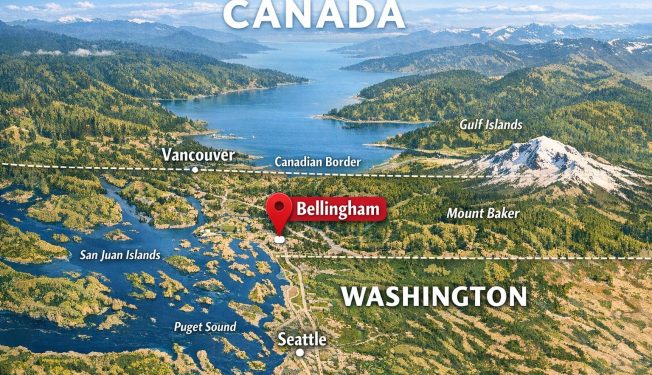
The Geographic Location of Bellingham
Bellingham is positioned in the northwestern corner of the United States within the state of Washington, a region known for its coastal landscapes, temperate climate, and strong economic connections to the broader Pacific Northwest. The city lies along the shores of Bellingham Bay, an inlet of the Salish Sea, which links the area to a wider system of waterways stretching from Puget Sound to the Strait of Georgia. This coastal setting provides both natural advantages and scenic characteristics that define the city’s identity.
Situated in Whatcom County, Bellingham acts as the county’s largest urban center and a focal point for commerce, education, and transportation. Its geographical coordinates place it approximately 90 miles north of Seattle, one of the most influential metropolitan areas in the region, and roughly 21 miles south of the Canadian border. This positioning creates a unique midpoint between two major urban influences: Seattle in the United States and Vancouver, British Columbia, in Canada.
The surrounding environment further enhances Bellingham’s geographic significance. To the east lies the foothills of the Cascade Range, including Mount Baker, a prominent volcanic peak that influences local weather patterns and recreational activity. To the west, the bay opens toward a network of islands, collectively known as the San Juan Islands, which draw tourism and maritime activity.
Proximity to the Canadian Border
One of the defining aspects of Bellingham’s geography is its close proximity to the Canadian border. The city is approximately a 20- to 30-minute drive from the Peace Arch border crossing in Blaine, Washington. This crossing is one of the primary gateways between the United States and Canada on the West Coast and is directly connected by Interstate 5 in the United States and Highway 99 in British Columbia.
This infrastructure allows for efficient and predictable travel between Bellingham and Vancouver, a major Canadian city located about 50 miles to the north. As a result, Bellingham is often viewed as part of a broader cross-border corridor that supports regular movement of people, goods, and services. The ease of crossing fosters routine travel for purposes such as employment, education, shopping, and tourism.
Because of this accessibility, Bellingham serves not only as a local destination but also as a transitional hub for travelers moving between the two countries. Cross-border commuting, although influenced by regulations and wait times, remains a consistent feature of life in the region.
Importance of Bellingham’s Location
Bellingham’s location contributes significantly to its economic function and cultural development. Its proximity to Canada offers advantages that extend beyond simple convenience. The city occupies a strategic position within the Cascadia region, an informal designation that includes parts of Washington, Oregon, and British Columbia, characterized by shared economic interests and environmental features.
One notable aspect of this positioning is its role in regional commerce. Canadian visitors frequently travel to Bellingham for various consumer activities, taking advantage of pricing differences, product availability, and tax structures. Retail centers such as Bellis Fair Mall and numerous independent businesses benefit directly from this inflow of customers, which supports local employment and business growth.
At the same time, Bellingham’s location allows residents to access Canadian services and experiences with relative ease. This bidirectional movement enhances the city’s economic resilience and broadens the range of opportunities available to its population.
Beyond commerce, the geographic position encourages collaboration among institutions. Educational partnerships, environmental initiatives, and shared infrastructure planning are often shaped by the city’s proximity to an international boundary.
Economic and Cultural Exchange
The interaction between Bellingham and nearby Canadian communities creates an ongoing exchange that influences daily life in both areas. Economic ties are particularly visible in sectors such as retail, tourism, and transportation. Canadian shoppers may visit for fuel, groceries, and apparel, while American residents may travel north for cultural events, dining, or specific services.
This exchange also has a cultural dimension that extends into community activities and regional identity. Festivals, art exhibitions, and academic programs frequently include participants from both countries, reflecting a shared cultural space that transcends the boundary. The presence of Western Washington University in Bellingham contributes to this dynamic by attracting international students, including many from Canada, who add to the diversity of perspectives within the city.
In addition, cross-border collaboration often appears in environmental stewardship. The Salish Sea ecosystem spans both countries, and its preservation requires cooperative efforts. Bellingham’s location positions it as a participant in joint initiatives focused on marine conservation, fisheries management, and climate response.
Over time, this consistent interaction has shaped a regional culture that values accessibility, cooperation, and mutual benefit. The city maintains its American identity while simultaneously engaging with Canadian influences in a way that is practical rather than symbolic.
Transportation and Accessibility
Bellingham’s transportation infrastructure reflects its role as a connector between regions. Interstate 5 serves as the primary north-south route, linking the city directly to Seattle and continuing to the Canadian border. This highway is essential for both personal travel and commercial transportation, supporting the steady movement of goods and services.
Air travel is facilitated by Bellingham International Airport, which offers flights to several U.S. destinations. Notably, the airport has become an attractive option for Canadian travelers, particularly those from the Vancouver area. Lower operating costs and competitive pricing often make it a practical alternative for international flights originating in the United States.
Rail and bus services also contribute to regional mobility. Amtrak’s Cascades route connects Bellingham with cities such as Seattle, Portland, and Vancouver, providing an additional option for cross-border travel. Bus networks complement this service by offering frequent connections that accommodate both commuters and visitors.
Maritime access further enhances transportation diversity. The Port of Bellingham supports commercial shipping, fishing activity, and passenger ferry services, including routes to Alaska and the San Juan Islands. This combination of land, air, and sea connectivity strengthens the city’s integration into regional and international networks.
The overall accessibility of Bellingham reinforces its position as a gateway city. Whether serving travelers heading to Canada or functioning as a destination in its own right, its transportation systems are aligned with its geographical advantages.
Bellingham’s geographical position is a central element of its identity and function. Its placement near an international boundary, along a major coastal waterway, and within a connected regional corridor allows it to maintain strong economic and cultural ties beyond its immediate surroundings. These characteristics contribute to a stable and dynamic environment shaped by both local and cross-border influences. For more detailed information about visiting the city and exploring local attractions, refer to the official tourism resource at Bellingham Tourism website.