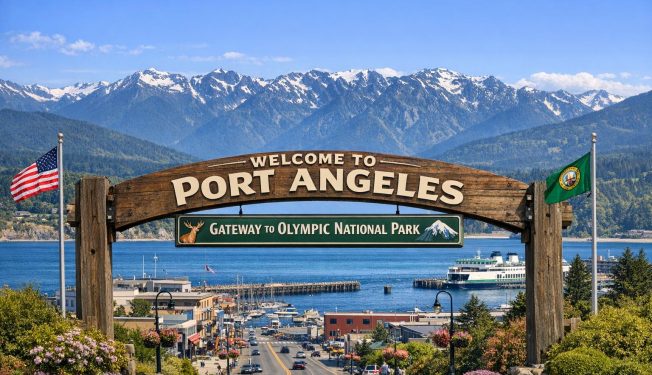
Introduction to Port Angeles
Port Angeles is a coastal city in the state of Washington, positioned along the northern edge of the Olympic Peninsula and facing the Strait of Juan de Fuca. As the county seat of Clallam County, it serves as an administrative, economic, and transportation center for the surrounding region. Its deep-water harbor and proximity to international shipping routes have made it an important maritime location for more than a century.
The city’s geographic position is particularly notable. To the north lies the Strait of Juan de Fuca, a key waterway that connects the Pacific Ocean to the inland waters of the Puget Sound. To the south, the terrain rises into the rugged Olympic Mountains, forming part of Olympic National Park. This unique setting places Port Angeles between marine and alpine environments, contributing to its identity as a transitional space between ecosystems.
Port Angeles is often described as a gateway community, particularly for travelers heading into Olympic National Park. Its infrastructure, including roads, lodging, and visitor services, supports a steady flow of tourists throughout the year. Despite its relatively modest population, the city plays a significant regional role due to its access to both natural resources and transportation networks.
History and Development
The history of Port Angeles begins long before European settlement. The area was traditionally inhabited by Indigenous peoples, primarily the Klallam tribe, who utilized the region’s abundant marine and forest resources. Fishing, hunting, and trade were central to their way of life, and the waters of the Strait of Juan de Fuca provided both sustenance and transportation routes.
European exploration of the area increased during the late 18th century. Spanish explorers are credited with naming the harbor “Puerto de Nuestra Señora de los Ángeles,” which later evolved into the name Port Angeles. Permanent settlement began in the mid-19th century, with the city officially established in 1862. Early development was driven by logging, fishing, and maritime trade, industries that took advantage of the region’s natural resources and access to waterways.
During the late 19th and early 20th centuries, Port Angeles expanded as infrastructure improved. Railways, docks, and industrial facilities were constructed to support the export of timber and other goods. The city was once considered as a potential site for a national capital due to its strategic location, though this proposal did not materialize.
Over time, the local economy diversified. While logging remained important for decades, environmental regulations and changing market conditions led to a gradual shift toward tourism and service-based industries. Today, Port Angeles reflects a blend of its industrial heritage and its role as a hub for outdoor recreation.
Maritime Economy
The maritime sector continues to be a defining aspect of Port Angeles. The Port of Port Angeles operates as a key facility for cargo handling, vessel services, and marine industries. Its deep-water harbor allows it to accommodate a variety of ships, including commercial freighters, research vessels, and recreational boats.
Fishing remains an active industry, though on a smaller scale compared to earlier periods. Local fisheries target species such as salmon, crab, and halibut, contributing to both the economy and regional food systems. In addition, boat building and repair services support commercial and private vessels operating in the area.
International connections are also facilitated through maritime routes. A ferry service links Port Angeles to Victoria, British Columbia, providing both passenger and limited vehicle transport. More information about this connection can be found at https://www.cohoferry.com. This cross-border link enhances tourism and trade, reinforcing the city’s role as an accessible entry point to the United States.
Recreational boating and cruise traffic further contribute to harbor activity. Seasonal visitors arrive by water, supporting local businesses and adding to the diversity of maritime operations. The harbor itself is supported by infrastructure designed for both economic efficiency and environmental management.
Gateway to Olympic National Park
One of the most significant aspects of Port Angeles is its proximity to Olympic National Park. The park encompasses nearly one million acres and includes diverse ecosystems such as temperate rainforests, alpine peaks, and rugged coastline. Port Angeles functions as one of the primary access points, particularly for visitors entering from the north.
The park’s boundaries extend close to the city, with popular destinations like Hurricane Ridge located within a relatively short driving distance. This accessibility allows visitors to experience dramatic elevation changes within a single day, moving from sea level to mountainous terrain.
Olympic National Park is recognized for its ecological diversity and has been designated both a UNESCO World Heritage Site and an International Biosphere Reserve. The park supports a wide range of plant and animal species, including endemic wildlife that is found nowhere else. As a nearby urban center, Port Angeles provides essential services such as lodging, dining, equipment rental, and visitor information.
Recreational Activities
Recreation plays a central role in the identity of Port Angeles. The surrounding landscape offers opportunities for outdoor activities throughout the year. Hiking is among the most popular pursuits, with trails ranging from short nature walks to multi-day backcountry routes. Hurricane Ridge, in particular, offers panoramic views and access to alpine environments.
Water-based activities are also prominent. Kayaking in the Strait of Juan de Fuca allows participants to explore coastal features and observe marine life. Whale watching tours operate seasonally, providing opportunities to see species such as orcas, gray whales, and humpbacks in their natural habitat. Additional information on local tours can be found at https://www.pugetsoundexpress.com.
Fishing, both recreational and commercial, remains a common activity. Charter services are available for those seeking guided experiences. Beaches along the peninsula provide areas for exploration, tide pooling, and photography.
During winter months, nearby mountainous areas receive snowfall, enabling activities such as skiing and snowshoeing. This seasonal variation enhances the region’s appeal, allowing for year-round tourism and diverse recreational options.
Access and Transportation
Port Angeles is relatively accessible despite its location on the Olympic Peninsula. Travelers from Seattle commonly reach the city by driving and utilizing ferry services across Puget Sound. One common route involves taking a ferry from Seattle to Bainbridge Island and then continuing by road across the Kitsap Peninsula and along the Hood Canal.
Another option is to travel via ferry directly from Victoria, British Columbia. This international connection provides a convenient route for Canadian visitors and adds to the city’s role as a cross-border transit point.
Highway access is primarily provided by U.S. Route 101, which encircles the Olympic Peninsula and connects Port Angeles to other regional destinations. While the area does not have a major airport, small regional flights and nearby airports in Seattle provide additional access for longer-distance travelers.
Public transportation options within the region include buses and limited shuttle services, some of which are designed to connect visitors to key locations within Olympic National Park. These services help reduce traffic congestion and support sustainable travel practices.
Local Services and Amenities
Port Angeles offers a range of services that support both residents and visitors. Accommodation options include hotels, motels, bed-and-breakfast establishments, and vacation rentals. These facilities vary in scale and price, accommodating different travel preferences.
Dining options reflect both local and international influences. Seafood is a prominent feature, with many establishments offering dishes based on locally sourced fish and shellfish. In addition, restaurants serving a range of cuisines contribute to the diversity of the local food scene.
Retail and service businesses are concentrated in the downtown area and along key transportation routes. Shops provide outdoor gear, clothing, and souvenirs, while rental services offer equipment such as bicycles, kayaks, and camping supplies. These businesses support the needs of visitors preparing for outdoor activities.
Healthcare, education, and public services are also available within the city, supporting a stable residential community. Libraries, parks, and cultural institutions contribute to the quality of life and provide additional points of interest beyond outdoor recreation.
Environmental Considerations
The environmental context of Port Angeles is significant due to its proximity to protected areas and sensitive ecosystems. Efforts to balance development with conservation are evident in regional planning and policy. The presence of Olympic National Park places additional emphasis on maintaining ecological integrity.
Local initiatives have focused on sustainability, including habitat restoration, water quality management, and responsible tourism practices. These efforts aim to protect natural resources while allowing for continued economic activity.
Climate and weather patterns in the region are influenced by both marine and mountainous factors. The area experiences relatively mild temperatures and significant precipitation, particularly during the winter months. These conditions contribute to the lush vegetation and diverse habitats found throughout the region.
Conclusion
Port Angeles occupies a distinctive position on the Olympic Peninsula, shaped by its maritime heritage, natural surroundings, and role as a regional hub. Its location along the Strait of Juan de Fuca and adjacent to Olympic National Park provides both economic opportunities and environmental responsibilities.
The city continues to adapt to changing conditions, balancing traditional industries with tourism and service sectors. Its infrastructure supports access to one of the most diverse natural landscapes in the United States, making it a practical base for exploration as well as a functioning community.
Through its combination of history, geography, and modern development, Port Angeles remains an important center for transportation, recreation, and regional identity in Washington State.