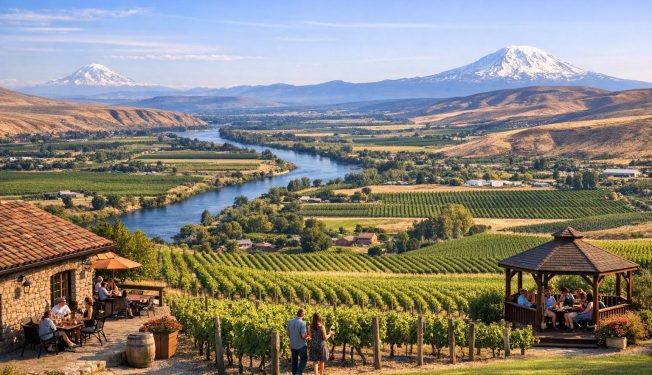
Introduction to Yakima Valley
The Yakima Valley, located in the south-central region of Washington State, is one of the most productive agricultural corridors in the United States. Extending across a broad stretch of land that follows the Yakima River, the region supports a highly varied and commercially significant agricultural system. While it is widely recognized for its apples and hops, Yakima Valley is particularly notable for its role in American viticulture. The area contributes a substantial share of Washington State’s wine grapes, reinforcing its importance in the national and international wine markets.
The valley’s agricultural identity has developed over more than a century, shaped by both natural conditions and extensive human investment in irrigation and land management. Today, Yakima Valley operates as a structured and commercially integrated region, where vineyards coexist with orchards, hop fields, and food processing facilities. This layered agricultural framework has allowed the valley to adapt to shifting market demands while maintaining consistent output.
Geography and Climate
Yakima Valley lies to the east of the Cascade Mountains, which play a decisive role in shaping its climate. The mountain range creates a rain shadow effect, limiting precipitation and producing a semi-arid environment. Annual rainfall in the valley is relatively low, averaging between 6 and 8 inches, which necessitates a robust irrigation system to sustain agriculture.
The Yakima River serves as the primary water source for irrigation, supported by an extensive network of canals and reservoirs that distribute water efficiently across farmland. This controlled irrigation allows growers to regulate moisture levels precisely, which is particularly important for grape production. Carefully managed water stress in vines can enhance flavor concentration and structural balance in the resulting wines.
Temperature variation is another defining feature of the valley’s climate. Summers are typically hot and dry, with daytime temperatures often exceeding 90°F (32°C), while nights cool significantly. This diurnal temperature shift is beneficial for grape development, as it allows sugars to accumulate during the day while preserving acidity during cooler nights. Winters, on the other hand, are cold, occasionally bringing freezing conditions that can pose risks to vineyards but also help control pests and diseases.
The valley’s soils are largely derived from volcanic activity, combined with layers of loess and alluvial deposits. These soils tend to be well-draining and relatively low in organic matter, conditions that encourage deep root growth in vines. As a result, grapevines often develop complex flavor profiles influenced by the mineral composition of the soil.
History of Wine Production
Wine production in Yakima Valley dates back to the mid-19th century, when early settlers began experimenting with grape cultivation. These initial efforts were modest and often limited by a lack of infrastructure and technical knowledge. However, they established the foundation for what would eventually become a sophisticated wine industry.
The modern era of wine production in Yakima Valley began in the 1960s and 1970s, driven by research and innovation. Institutions such as Washington State University played a significant role in studying grape varieties suitable for the region’s climate, as well as refining vineyard management techniques. These efforts helped demonstrate that Yakima Valley could produce high-quality wine grapes comparable to more established regions.
In 1983, Yakima Valley was officially designated as Washington State’s first American Viticultural Area (AVA). This designation recognized the region’s distinct geographic and climatic characteristics, often referred to as its terroir. The AVA status also provided a framework for marketing and quality assurance, allowing producers to differentiate their wines in an increasingly competitive marketplace.
Since then, the valley has expanded its vineyard acreage and winery operations significantly. New plantings have diversified the range of grape varieties, while advances in technology have improved both efficiency and product consistency. Today, Yakima Valley serves as a central component of Washington’s broader wine industry, which ranks among the largest in the United States.
Grape Varieties
Yakima Valley’s range of microclimates allows for the cultivation of a wide variety of grape types. Variations in elevation, soil composition, and temperature create distinct growing conditions within relatively short distances. This diversity enables growers to match specific grape varieties to suitable vineyard sites.
Among white grape varieties, Chardonnay remains one of the most widely planted. It adapts well to the valley’s conditions, producing wines that balance acidity with fruit character. Riesling is another important white variety, known for its ability to retain acidity and develop aromatic complexity in cooler sites. Sauvignon Blanc is also cultivated, contributing to a range of fresh and structured white wines.
Red grape production is equally significant. Cabernet Sauvignon thrives in warmer areas of the valley, developing concentrated flavors and firm tannins. Merlot is valued for its adaptability and softer profile, often used both as a varietal wine and in blends. Syrah has gained prominence for its ability to express both fruit intensity and earthy characteristics, depending on the vineyard location.
In addition to these established varieties, some growers experiment with less common grapes such as Tempranillo, Grenache, and Mourvèdre. These efforts reflect an ongoing interest in expanding the region’s viticultural portfolio and responding to changing consumer preferences. The presence of multiple grape types also supports a wide range of wine styles, from single-varietal bottlings to complex blends.
Viticultural Practices and Innovation
Viticulture in Yakima Valley is highly managed and increasingly influenced by technological advancements. Vineyard operators rely on data-driven approaches to monitor soil moisture, weather patterns, and vine health. Tools such as remote sensing, satellite imagery, and precision irrigation systems help optimize resource use and improve crop quality.
Sustainability has become an important consideration in recent years. Many vineyards participate in certification programs that promote environmentally responsible practices, including reduced pesticide use, water conservation, and soil health management. These initiatives are often supported by regional organizations and industry groups working to align agricultural productivity with environmental stewardship.
Labor also plays a central role in vineyard operations. Seasonal workforces are essential for tasks such as pruning, canopy management, and harvesting. Mechanization has increased in certain areas, particularly for harvesting, but manual labor remains important for maintaining quality in many vineyards.
Research continues to influence vineyard practices, particularly in areas such as disease resistance and climate adaptation. As weather patterns evolve, growers are exploring new rootstocks and canopy management techniques to maintain consistent yields and quality.
Visiting Yakima Valley Wineries
Yakima Valley offers a structured and accessible environment for visitors interested in wine tourism. The region features a network of wineries that range from small, family-operated establishments to larger commercial producers. Many of these wineries are located along designated routes, allowing visitors to plan coordinated tasting experiences.
Treveri Cellars, located in Wapato, focuses on sparkling wine production using traditional methods. The facility is positioned to provide views of surrounding vineyards, and its tasting room offers insight into the production process. More information can be found at Treveri Cellars.
Kiona Vineyards and Winery, situated on Red Mountain, is one of the region’s established producers. Known for its red varietals and blends, Kiona offers tastings that highlight the characteristics of Red Mountain’s warmer climate. Additional details are available at Kiona Vineyards.
In addition to individual wineries, organized events such as seasonal wine festivals and vineyard tours provide broader access to the region’s offerings. These events often combine tastings with educational components, including discussions of grape growing and winemaking techniques. Visitors can find updated information through local tourism platforms such as Visit Yakima.
Infrastructure supporting tourism includes lodging, transportation services, and dining options that emphasize locally sourced ingredients. This integration of agriculture and tourism contributes to the regional economy while offering visitors a structured way to engage with Yakima Valley’s wine culture.
Economic and Cultural Significance
Yakima Valley’s wine industry is closely tied to the region’s broader agricultural economy. Vineyards, wineries, and associated businesses generate employment and contribute to regional revenue. The wine sector also supports related industries, including packaging, transportation, and marketing.
Culturally, the presence of wineries has influenced local identity, incorporating wine production into community events and regional branding. Educational institutions and industry associations provide training and support for individuals entering the field, ensuring a steady transfer of knowledge and skills.
The valley’s agricultural diversity reinforces its economic resilience. While wine production is a key component, it operates alongside other crops, allowing the region to maintain stability despite fluctuations in specific markets. This balance has been a defining characteristic of Yakima Valley’s development.
Conclusion
Yakima Valley represents a significant and evolving component of Washington State’s wine industry. Its combination of favorable climate conditions, diverse soils, and established infrastructure supports consistent grape production and wine quality. The region’s history reflects a transition from small-scale experimentation to a structured and technologically advanced agricultural system.
With its range of grape varieties, ongoing innovation in vineyard management, and accessible wine tourism framework, Yakima Valley continues to contribute to the broader recognition of American wines. Its role is both practical, in terms of production volume, and strategic, in shaping perceptions of Washington State as a leading wine-producing region.