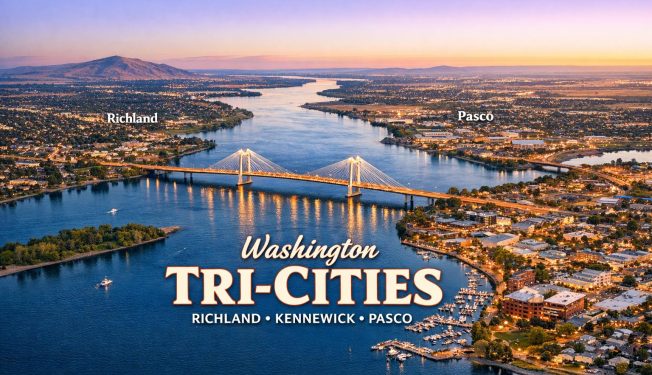
Geographical Overview
The Tri-Cities region in southeastern Washington State consists of the interconnected communities of Richland, Kennewick, and Pasco. These cities are positioned at the meeting point of the Columbia, Yakima, and Snake Rivers, forming a distinctive landscape shaped by water systems, sediment deposits, and broad plains. This confluence not only defines the physical geography of the region but also influences its economic and social development.
The area lies within the Columbia Basin, which is characterized by relatively flat terrain, rolling hills, and volcanic soil formations. This geography provides both challenges and opportunities. While the natural climate is dry, the river systems make large-scale irrigation possible, transforming otherwise arid land into productive farmland. The Tri-Cities also benefit from their location along important regional transportation corridors, linking them to major markets in the Pacific Northwest and beyond.
Richland
Richland occupies the northwestern portion of the Tri-Cities and is closely associated with scientific research and federal government activity. Its modern development is tied to its role in the Manhattan Project during World War II, when the nearby Hanford Site was established for nuclear materials production. This legacy continues to shape the city’s identity and infrastructure.
Today, Richland is home to the Pacific Northwest National Laboratory (PNNL), a major research institution that contributes to advancements in environmental science, energy systems, and national security. The laboratory collaborates with government agencies, universities, and private industry. Additional details about its research programs and initiatives are available at the official PNNL website.
Richland also features planned neighborhoods, extensive park systems, and riverfront access. The presence of research professionals and a highly educated workforce contributes to a stable local economy and supports a variety of technical and service industries. The city has developed infrastructure that accommodates both residential growth and institutional needs.
Kennewick
Kennewick is the largest city in the Tri-Cities region by population and functions as a central hub for retail, healthcare, and commercial services. Located along the southwestern bank of the Columbia River, it has experienced consistent growth driven by both migration and economic diversification.
The city’s commercial landscape includes regional shopping centers, medical facilities, and hospitality businesses. Healthcare services are a particularly significant component, with multiple hospitals and specialized clinics serving not only the Tri-Cities but also surrounding rural areas. Manufacturing and construction also contribute to Kennewick’s economic structure, supporting ongoing development.
Cultural and recreational events play a visible role in the city’s public life. The Tri-City Water Follies is one of the most prominent annual events, attracting visitors for hydroplane races held on the Columbia River. This event also reflects the broader relationship between the community and its waterways, which are used for both leisure and economic purposes.
Pasco
Pasco is located to the east, across the Columbia River, and serves as an important center for agriculture, transportation, and industry. The city benefits from direct access to rail lines and highways, making it a logistical node within the region. Its proximity to extensive farmland reinforces its role in food production and distribution.
Agriculture remains a defining feature of Pasco’s economy. The surrounding area produces a wide range of crops, including apples, cherries, wheat, and corn, with irrigation systems enabling consistent yields despite limited rainfall. Food processing and packaging facilities operate within the city, adding value to raw agricultural products before they are shipped to domestic and international markets.
Pasco is also home to the Tri-City Dust Devils, a minor league baseball team that contributes to local recreation and draws community participation. In addition to organized sports, Pasco’s public spaces and parks provide access to outdoor activities, often centered around the riverfront.
Climate and Environment
The Tri-Cities region experiences a semi-arid climate characterized by low annual precipitation, high summer temperatures, and relatively mild winters. Average rainfall is significantly lower than in western Washington, with most precipitation occurring during late fall and winter months.
Summer temperatures frequently exceed 90 degrees Fahrenheit, and dry conditions reduce humidity, influencing both comfort levels and agricultural practices. Winters tend to be cooler but not extreme, with occasional snowfall and periods of fog. Seasonal transitions are generally gradual, allowing for predictable agricultural cycles.
The environmental conditions make irrigation essential for farming. Water is diverted from the Columbia, Yakima, and Snake Rivers through an extensive system of canals and pumps. This infrastructure has been developed over decades and is critical for sustaining crop production. The combination of fertile soil and controlled water access allows the region to produce high yields across a range of crops.
Air quality and environmental management are ongoing considerations, particularly due to agricultural activity and historical industrial operations. Monitoring programs and regulatory frameworks are in place to address these concerns and maintain environmental standards.
Educational and Recreational Opportunities
The Tri-Cities region includes a range of educational institutions that support both local residents and regional development. Washington State University Tri-Cities is a key institution, offering undergraduate and graduate programs in fields such as engineering, business, environmental science, and education. The campus also engages in applied research that aligns with regional industries, including energy and agriculture.
In addition to higher education, the region supports community colleges, vocational training centers, and public school systems that serve a growing and diverse population. Workforce training programs are designed to meet the needs of local employers, particularly in technical and healthcare fields.
Recreational opportunities are closely tied to the natural environment. The river systems provide access to boating, fishing, and water sports, while a network of trails and parks supports hiking, cycling, and outdoor gatherings. Public investments in green spaces have led to the development of riverfront parks that connect the three cities and provide shared amenities.
Seasonal recreation includes organized sports leagues, community festivals, and cultural events that reflect both longstanding traditions and newer demographic influences. These activities contribute to the overall quality of life and support tourism within the region.
Transportation and Connectivity
Transportation infrastructure in the Tri-Cities region integrates road, rail, and air systems to facilitate both local mobility and regional connectivity. Major highways, including Interstate 82 and U.S. Route 395, link the area to larger cities such as Seattle, Spokane, and Portland. These routes are essential for the movement of goods, particularly agricultural products.
The Tri-Cities Airport, located in Pasco, provides commercial air service with connections to major hubs in the western United States. The airport supports both passenger travel and cargo operations, reflecting the region’s economic activities. Continued investment in airport facilities has expanded capacity and improved accessibility.
Rail infrastructure also plays a role in freight transportation, especially for bulk commodities. Public transit services operate within and between the three cities, offering bus routes that connect residential, commercial, and industrial areas. While private vehicle use remains prevalent, transit systems provide important alternatives for commuting and access.
Economic Landscape
The economy of the Tri-Cities region is characterized by diversification across several key sectors, including agriculture, energy, research, healthcare, and retail. This diversity contributes to economic stability and allows the region to adapt to changing market conditions.
The presence of major research institutions such as PNNL and the nearby Hanford Site underscores the importance of science and energy-related activities. These institutions generate employment opportunities, attract federal funding, and support a network of contractors and service providers. Cleanup and environmental management efforts at Hanford continue to represent a substantial component of regional employment.
Agriculture remains foundational, supported by both primary production and value-added processing. Export markets are significant, with products distributed across the United States and internationally. Advances in agricultural technology and irrigation methods have further increased productivity.
Healthcare and education sectors provide additional economic support, offering stable employment and services that attract and retain residents. Retail and hospitality industries have expanded in response to population growth, contributing to the development of commercial districts.
Overall, the Tri-Cities region demonstrates a balance between traditional industries and emerging sectors. Its geographic advantages, infrastructure, and institutional presence collectively position it as a significant economic center within Washington State.