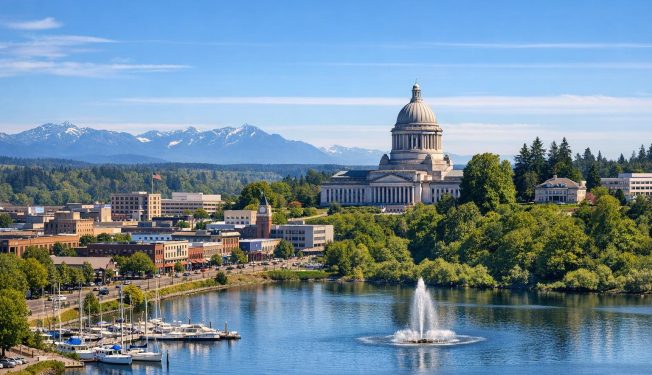
Overview of Olympia, Washington
The city of Olympia is the capital of the state of Washington, located in the Pacific Northwest region of the United States. It serves as the administrative center for Thurston County and functions as a hub for state-level governance, regional planning, and civic life. Positioned along the southern edge of Puget Sound, Olympia combines the characteristics of a government town with those of a waterfront community. Its scale remains relatively modest compared to other capital cities, yet it plays a significant role in shaping policy and administration across the state.
Olympia’s identity is shaped by the interplay between public institutions, natural landscapes, and a population that is actively engaged in community affairs. Government offices, educational institutions, and small businesses coexist with public green spaces and marine shorelines. The result is a city that balances administrative function with environmental and cultural awareness.
Geographic Location
Olympia sits at the southern tip of Puget Sound, a complex estuarine system that connects inland waters with the Pacific Ocean. This location places the city within a region known for its marine ecosystems, forested terrain, and varied topography. The surrounding environment includes inlets, tidal flats, wetlands, and evergreen forests, all of which contribute to the ecological diversity of the area.
The city’s geographic coordinates are approximately 47.0379° N latitude and 122.9007° W longitude. Olympia’s position also places it within a network of regional transportation routes, including Interstate 5, which runs north-south through western Washington. This allows relatively easy travel to nearby cities such as Tacoma, Seattle, and Portland, Oregon.
Climate in Olympia is classified as a temperate marine climate, characterized by mild, wet winters and relatively dry summers. Rainfall is common during much of the year, contributing to the region’s dense vegetation. Seasonal temperature variation is generally moderate, with limited extremes compared to inland areas.
The city’s waterfront along Budd Inlet provides both scenic value and practical use. Harbors, marinas, and public access points allow for boating and shoreline recreation. The Deschutes River flows into Capitol Lake and then into Budd Inlet, forming a distinctive hydrological feature at the center of Olympia.
Historical Background
Olympia’s history extends back thousands of years, with indigenous tribes such as the Nisqually, Squaxin Island, and other Coast Salish peoples establishing long-standing communities in the region. These groups relied on the local environment for sustenance, engaging in fishing, shellfish harvesting, and trade across waterways. Cultural and economic systems were closely tied to the rhythms of the land and sea.
European and American settlement began in the mid-19th century, bringing significant changes to the region’s social and economic structures. Olympia was officially incorporated in 1859, though it had already been designated as the capital of the Washington Territory in 1853. When Washington became a state in 1889, Olympia retained its status as the capital.
During the late 19th and early 20th centuries, Olympia developed as a regional center for commerce and industry. The availability of timber resources and access to waterways supported the growth of logging and milling operations. Over time, the presence of government institutions became increasingly central to the city’s identity.
Historic buildings in the city, particularly around the downtown and capitol campus areas, reflect architectural styles from different periods of development. Preservation efforts have maintained many of these structures, providing continuity between Olympia’s past and present.
Economy and Industry
Historically, Olympia’s economy was based largely on natural resource extraction, particularly timber and logging. These industries played a central role in the early development of the region, supporting employment and infrastructure growth. As the economy evolved, reliance on resource-based industries diminished, and new sectors emerged.
Today, the public sector dominates Olympia’s economy. As the seat of state government, the city hosts numerous agencies, departments, and legislative offices. This concentration of public employment provides a stable economic foundation and influences the local job market.
In addition to government employment, healthcare represents a significant sector. Regional medical centers and healthcare providers serve both Olympia residents and surrounding communities. Education is another key area, with public schools, colleges, and specialized training institutions contributing to workforce development.
Retail and service industries support local needs, while small businesses and independent enterprises add diversity to the economic landscape. In recent years, there has been growth in professional services and technology-related activities, though these remain smaller components compared to government employment.
Economic planning in Olympia often emphasizes sustainability, local resilience, and environmental stewardship. Initiatives aimed at reducing environmental impact and promoting responsible land use are integrated into broader development strategies.
Culture and Arts
Olympia maintains an active cultural and artistic community that reflects a range of influences. Galleries, performance spaces, and community events provide opportunities for both established and emerging artists. Public art installations and exhibitions contribute to the visibility of creative work throughout the city.
The presence of The Evergreen State College plays a notable role in shaping Olympia’s cultural environment. The institution is known for its interdisciplinary and student-directed approach to education, which encourages experimentation and creativity. This influence extends beyond the campus into the broader community, supporting artistic initiatives and collaborative projects.
Music has also been an important aspect of Olympia’s cultural identity. The city has historically been associated with independent music scenes, hosting venues that support local and touring performers. Literary arts, film, and visual media are also represented through festivals, workshops, and public programming.
Local organizations and cultural institutions contribute to arts education and community engagement. Libraries, community centers, and nonprofit groups provide access to resources and events that encourage participation across age groups and backgrounds.
Parks and Recreation
Olympia’s parks and recreation system is an integral part of city life, offering a range of outdoor spaces that serve both ecological and recreational functions. Parks vary in size and purpose, from large natural preserves to neighborhood green spaces and waterfront areas.
Priest Point Park, also known as Squaxin Park, features forested trails, shoreline access, and views of Budd Inlet. It provides opportunities for walking, wildlife observation, and informal recreation. Mills D. Thompson Nature Preserve focuses on habitat conservation, offering quieter trails and educational signage related to local ecosystems.
Capital Lake, located near the state capitol campus, serves as a focal point for public gatherings and outdoor activity. The surrounding paths are used for walking, running, and cycling. Ongoing environmental discussions address the management and future of this engineered water body.
The city also maintains sports fields, playgrounds, and community facilities that support organized activities. Seasonal programs and recreational classes are offered through municipal services, providing structured opportunities for participation.
Olympia functions as a gateway to larger regional attractions. Visitors and residents often travel to nearby destinations such as the Olympic National Park, known for its diverse ecosystems; the Mount Rainier National Park, featuring volcanic landscapes and alpine environments; and the Kitsap Peninsula, which offers additional coastal and forested areas.
Demographics and Population
As of recent estimates, Olympia has a population of approximately 55,000 residents. The broader metropolitan area, which includes neighboring communities such as Lacey and Tumwater, forms a larger regional population center. Growth trends have been steady, influenced by Olympia’s role as a government hub and its proximity to larger cities.
The demographic composition of Olympia reflects a diversity of cultural backgrounds, age groups, and household types. Educational attainment levels tend to be relatively high, due in part to the presence of higher education institutions and public sector employment requirements.
Housing in Olympia includes a mix of single-family homes, apartments, and multi-unit developments. Urban planning efforts address issues such as affordability, density, and land use. Strategies to manage growth while preserving environmental quality are ongoing priorities for local government.
Community engagement is a notable feature of life in Olympia. Public participation in planning processes, local elections, and civic initiatives contributes to the city’s governance model. Many residents are involved in volunteer activities, neighborhood associations, and advocacy groups.
In summary, Olympia’s role as a state capital shapes much of its economic and institutional structure, while its geographic setting and community values influence its cultural and environmental character. The city integrates administrative function with access to natural resources, offering a setting where governance, daily life, and recreation intersect.